Restrict a preorder offer to specific markets
Use this guide if you sell in multiple Shopify markets and want a preorder offer to show only in some of them, for example a specific region, or a market with different stock or shipping needs. By the end, the preorder button will show only in the markets you select; customers in every other market see the standard product experience instead.
Before you begin
| Requirement | Detail |
|---|---|
| Active preorder offer | You need at least one offer. See Set up preorders. |
| Paid STOQ plan | The Specific markets option is disabled on free plans. An upgrade prompt appears in the section when you're on a free plan. |
| Shopify Markets configured | Markets listed here are pulled from your Shopify admin (Settings > Markets). Only markets that exist in Shopify appear in the picker. |
Choose your setup
The Markets section of a preorder offer has two options:
| Option | Behavior |
|---|---|
| All markets | The preorder button shows to customers in every Shopify market. This is the default. |
| Specific markets | The preorder button shows only in the markets you select. Requires a paid plan. |
What customers will see
Customers browsing from a market you selected see the preorder button as normal. Customers browsing from any other market see the standard product experience instead, typically an Add to cart button if the product is in stock, or a sold-out state if it isn't. STOQ controls only the preorder button and its widget; Shopify controls the rest of the product page and checkout.
Set it up
On a phone, this menu is collapsed. In the Shopify mobile app, tap the STOQ logo at the top of the screen to open it, then choose the section named below. There is no hamburger icon. See Finding the STOQ menu.
Open the offer's Markets section
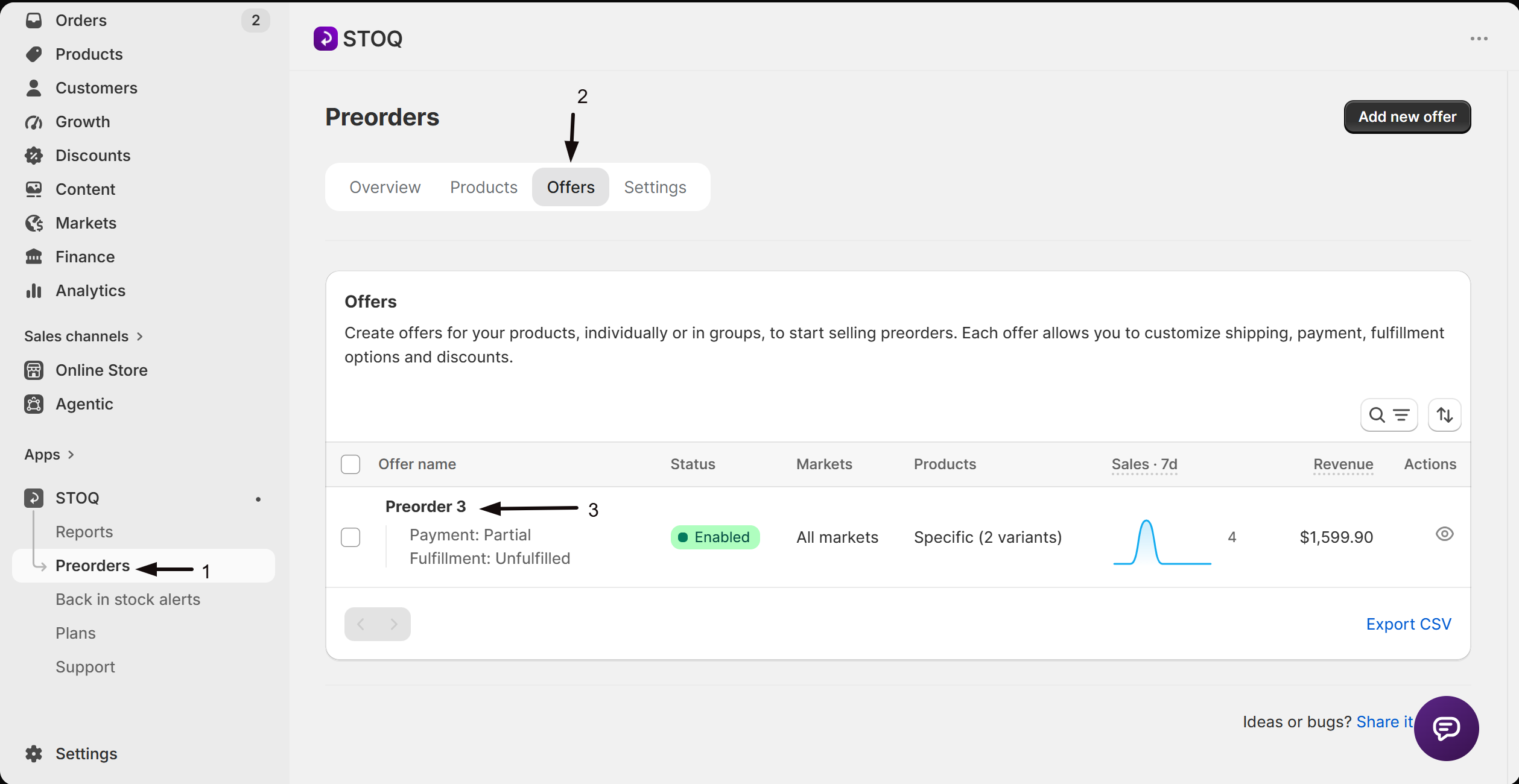
- In the left menu bar of the STOQ app, click Preorders.
- Click the Offers tab.
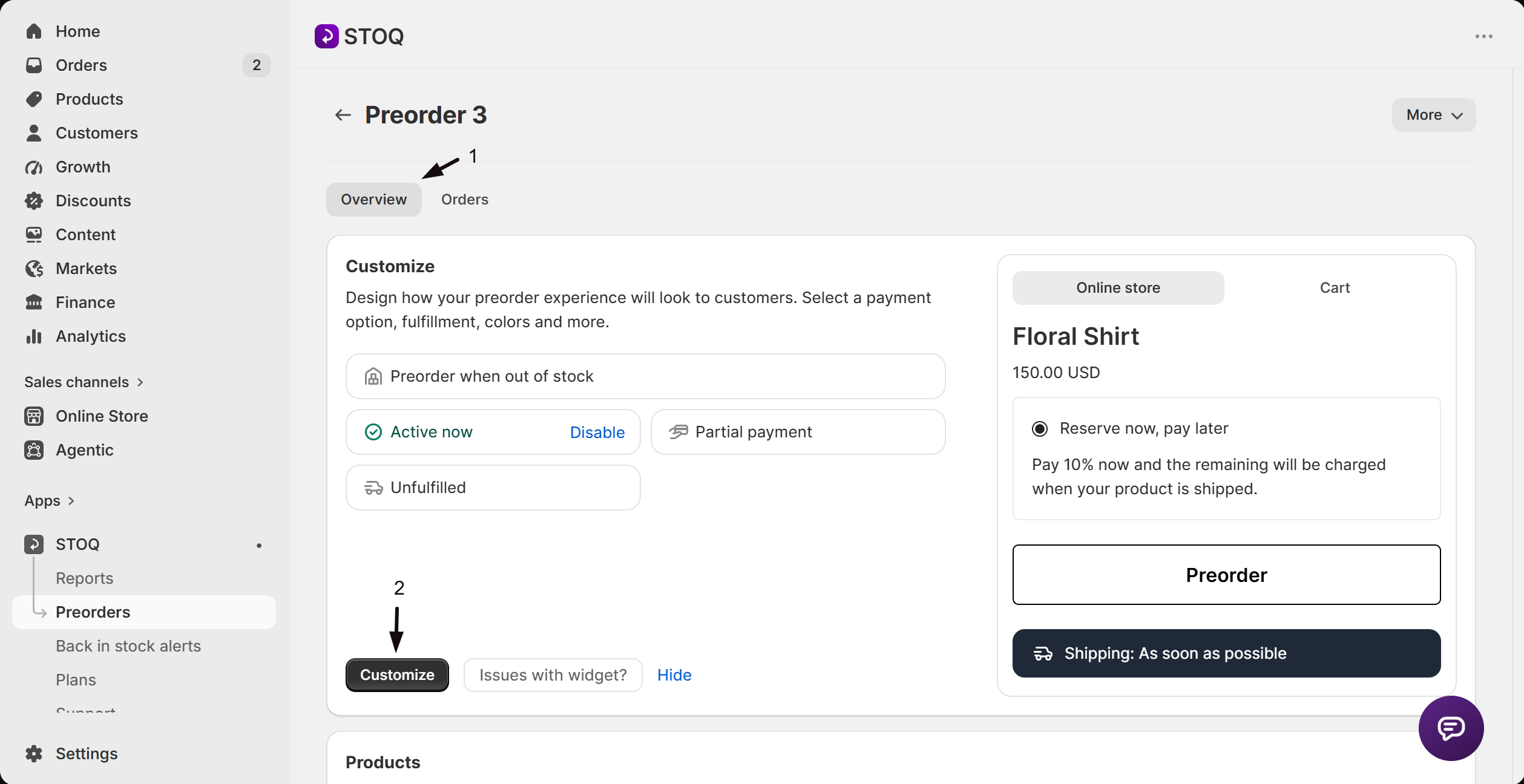
- Click the offer you want to edit. Its Overview tab opens, showing the Customize button, a live preview, and the offer's Products section.
- Click Customize to open the editor.
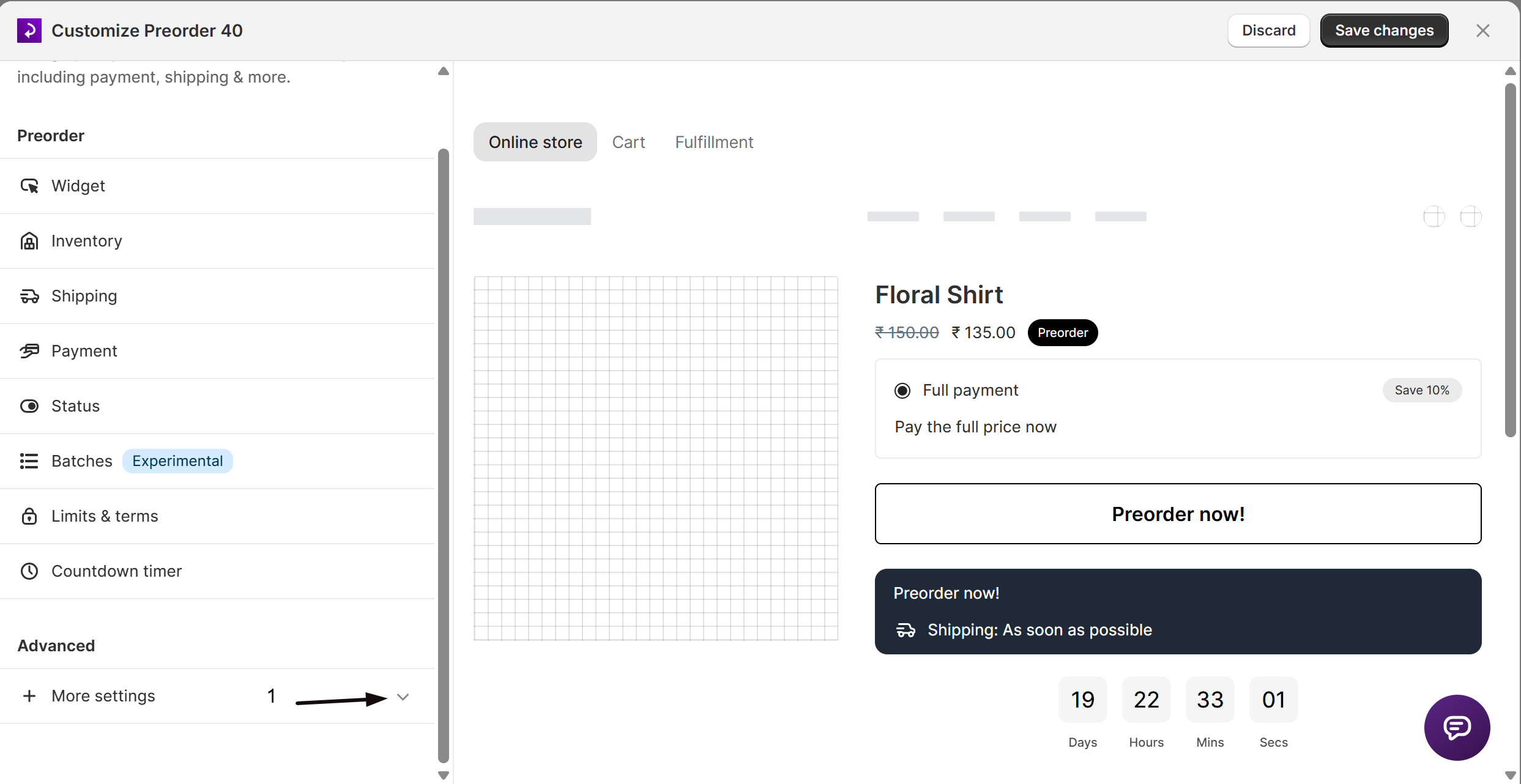
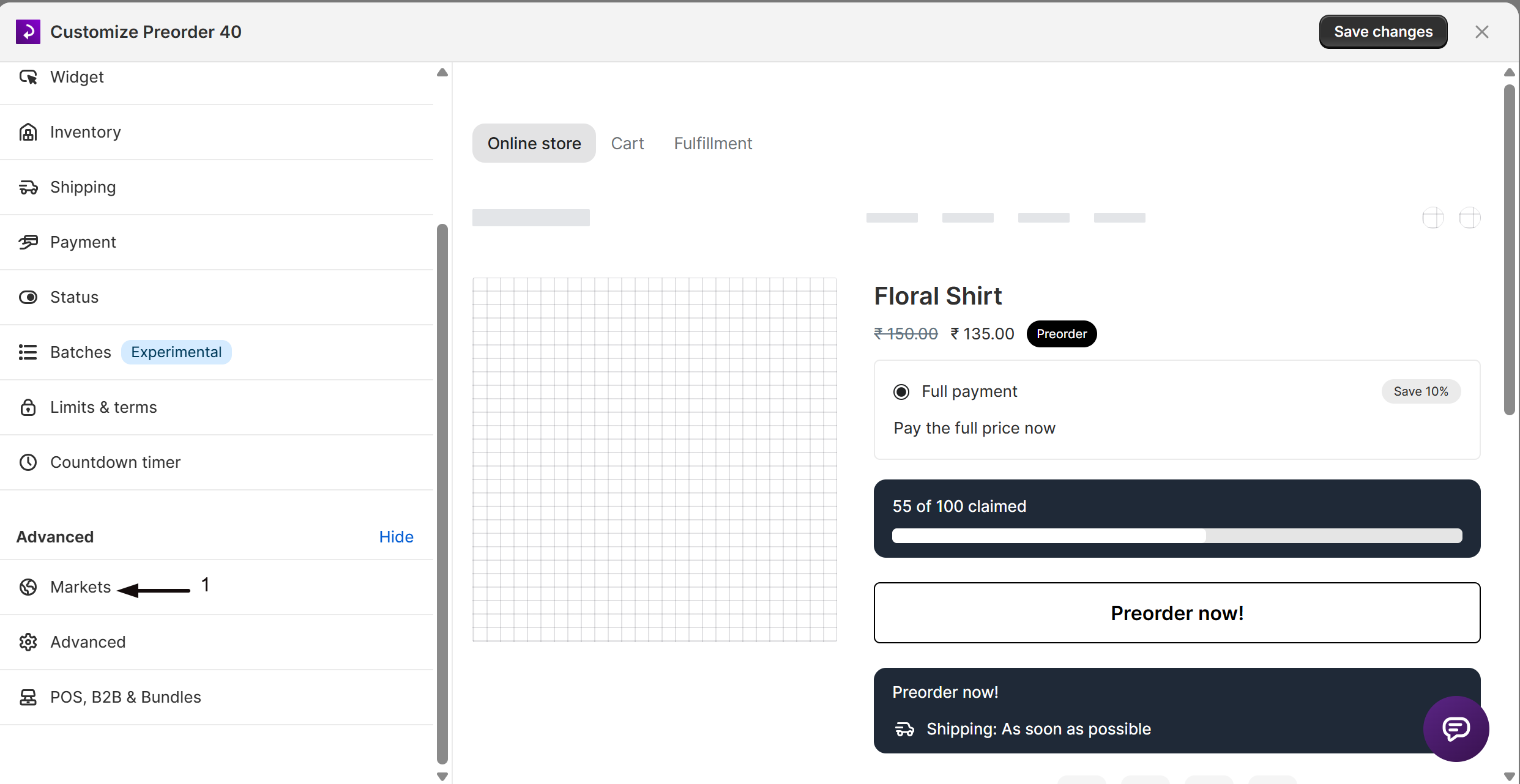
- In the settings list, click More settings to expand it, then click Markets (globe icon).
Select Specific markets
Choose Specific markets. See Choose your setup above for how this differs from All markets.
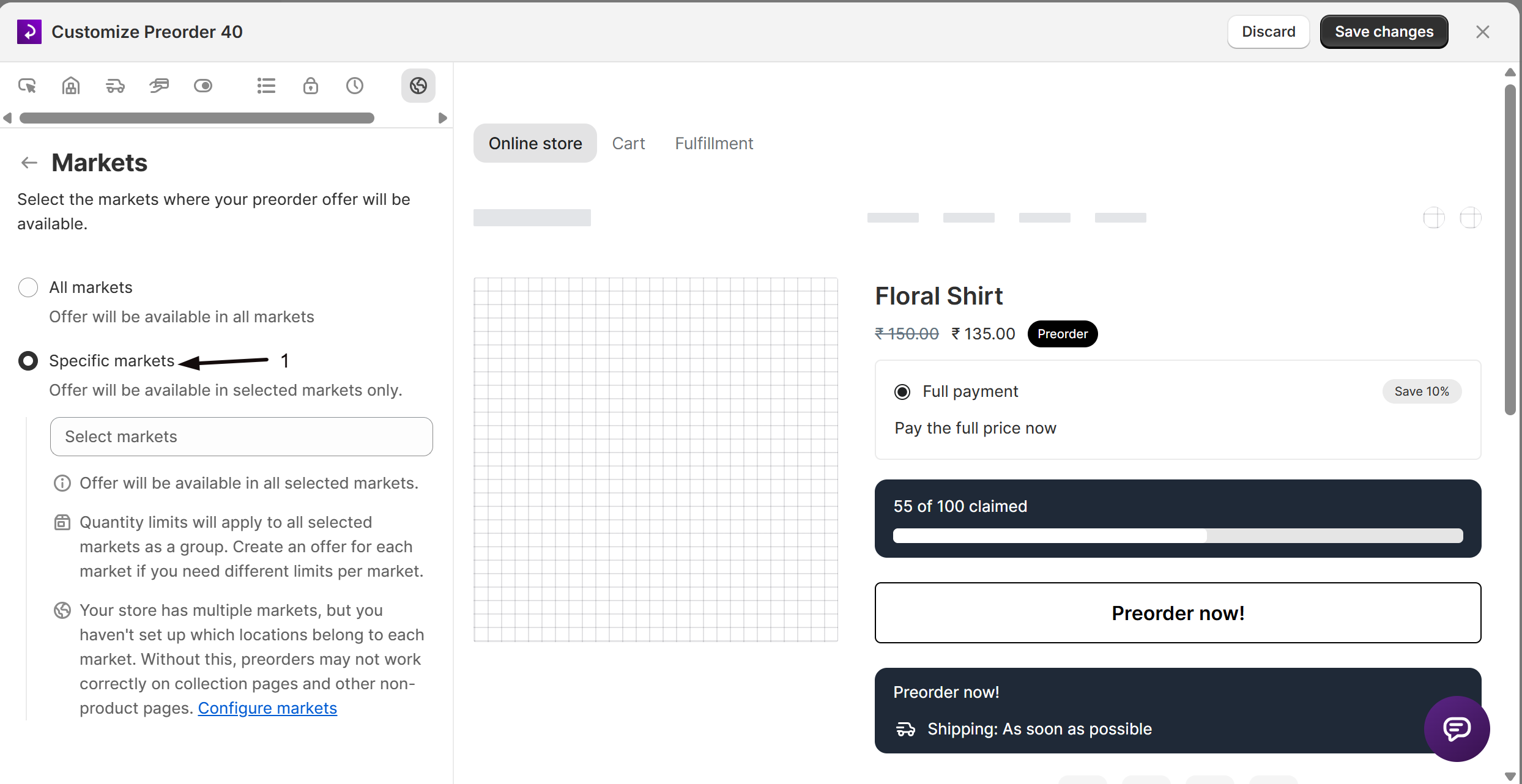
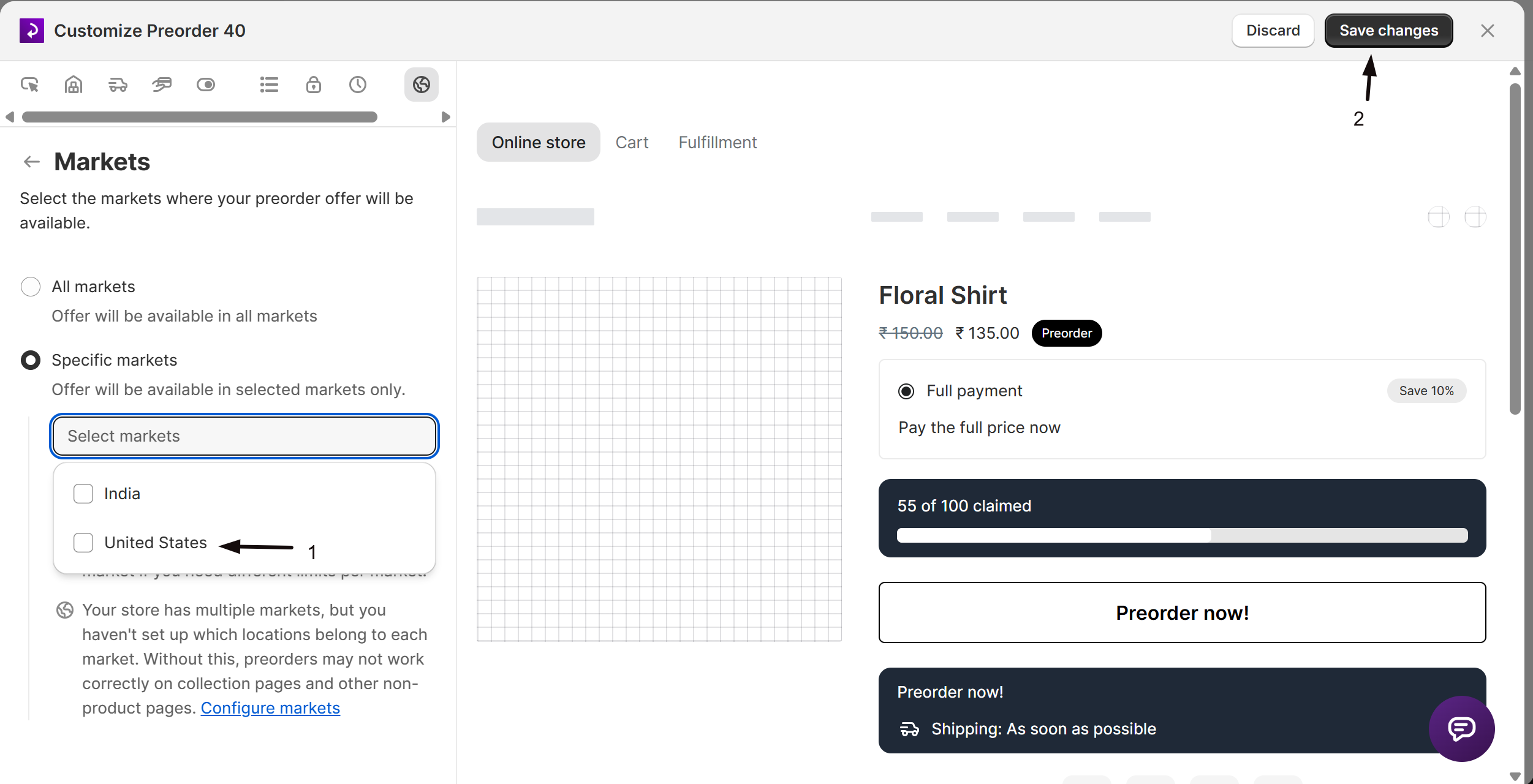
Select markets from the picker
- Click inside the search field that appears and start typing a market name.
- Select one or more markets from the dropdown (selected markets appear as removable tags above the search field; click the x on a tag to remove it).
At least one market must be selected to save; saving with none shows a validation error.
Configure market locations when prompted
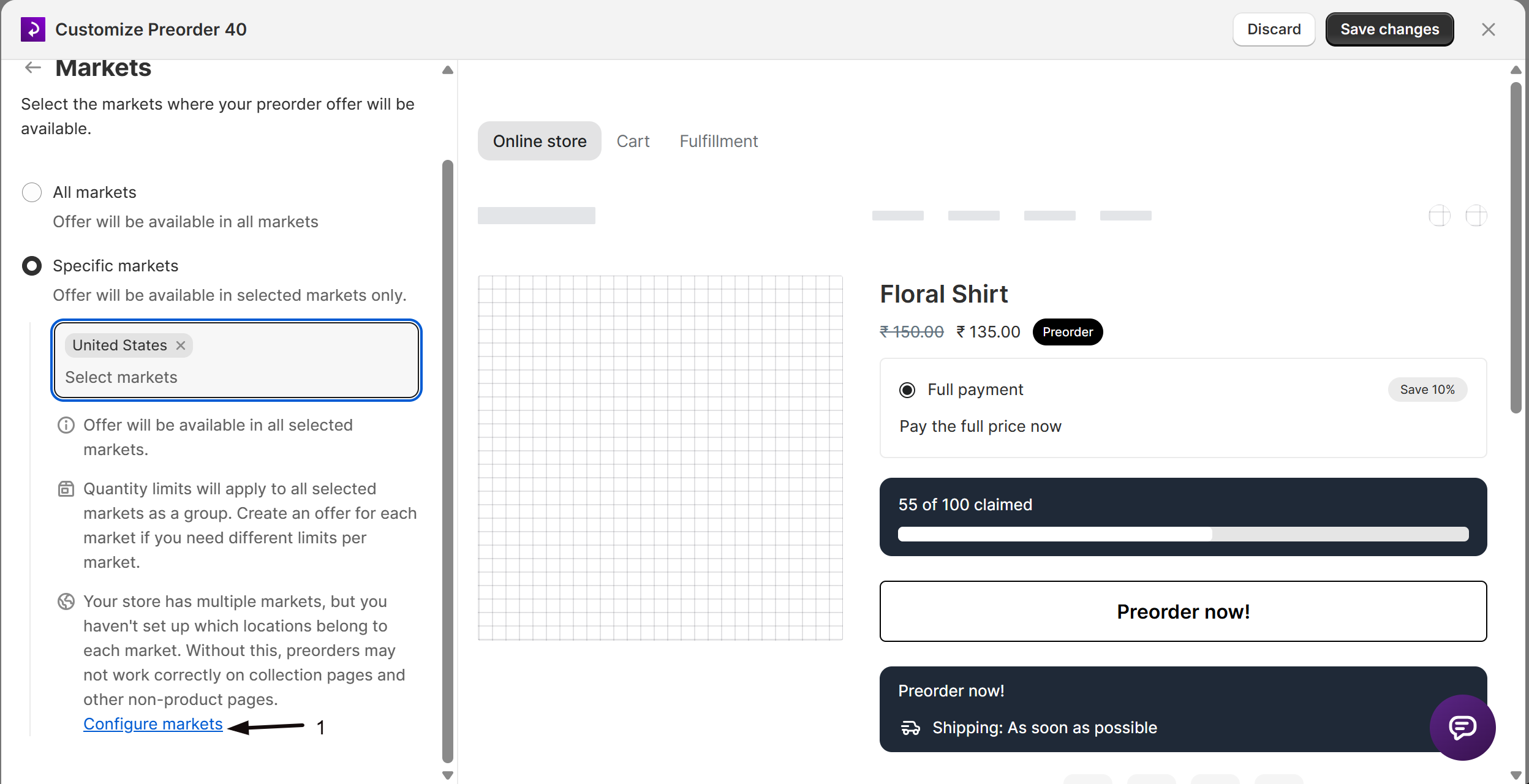
If your store has multiple markets but you haven't mapped which locations belong to each market, a note asks you to configure this. Without it, the preorder button may not show correctly on collection, home, and search pages.
Click **Configure markets** to open the Locations & Markets settings and map each market to its fulfillment locations.Save changes
Click Save changes at the top right of the editor. The market selection takes effect immediately on the online storefront.
Check your setup
- Visit a product page linked to this offer while browsing from a market you selected. The preorder button should appear.
- Visit the same product page while browsing from a market that isn't in your selection. The preorder button should not appear.
Check product status by market
When an offer covers more than one market, the offer's Products section can show each variant's status for a specific market, so you can confirm the offer behaves the way you expect region by region without leaving STOQ.
Open the offer's Products section
Open the offer (Preorders in the left menu, then the Offers tab, then open your offer) and go to its Products section.
Filter by market
Click the globe icon at the top of the products list (labeled Market). Under Product status by market, choose a market to see each variant's status for that region, or All markets for the combined view.
Each variant's status reflects the inventory at the locations mapped to the market you pick, so the same variant can read differently from one market to the next. The globe filter appears only when the offer has more than one market assigned.
Products shared between market offers
If you run one offer per market, for example a US offer and an Australia offer, the same products are often in both. Continue selling when out of stock is one Shopify setting per product, shared by every offer that includes it. If you turn it off from one offer, customers can no longer preorder that product in the other offer either.
STOQ warns you before this happens. When you choose to turn Continue selling off from an offer set to Specific markets, and another enabled Specific markets offer still includes some of the products, a warning appears at the top of the same box. It shows:
- How many of the products are also in another active preorder offer.
- Each affected offer by name, with how many of its products are affected.
The warning can appear in any box where you can turn Continue selling off:
- Disable offer?, when you disable an offer and keep Yes selected.
- Schedule offer, when you schedule an offer to start later and keep Yes selected.
- Disable preorder offers, after you select offers on the Offers tab and click Disable offers.
- Toggle 'Continue selling', from an offer's Products section or from the Products tab. On the Products tab, every enabled Specific markets offer that includes the selected products is listed.
- Remove variants, when you remove variants from an offer's Products section.
- Continue selling setting, when you change the offer's products between Specific products, Collection and All products.
The warning only shows while the turn-off option is selected. If you pick the option that keeps Continue selling on, or leaves it unchanged, the warning disappears. STOQ doesn't block anything and applies exactly what you choose. To keep taking preorders in the other market, keep Continue selling on for those products.
Offers set to All markets are never checked. Acting from an All markets offer shows no warning, even if a Specific markets offer shares the products, so check your other offers yourself before you turn Continue selling off there. If you disable several offers together with Disable offers, the offers you're disabling don't count against each other.
Troubleshooting
The preorder button isn't showing on collection, home, or search pages for some markets
This is usually missing location-to-market mapping.
- Open the pages editor: Preorders in the left menu -> Settings tab -> Pages sub-tab -> Customize.
- Open Locations & Markets under Advanced.
- Switch to Multiple markets.
- Map each market to its locations.
Saving shows "At least one market must be selected when specific markets is enabled"
Select at least one market from the picker before saving.
Specific markets is disabled
You're on a free plan. Click the Upgrade link next to the option to unlock market-level control.
Preorders stopped in one market after changing another market's offer
Continue selling was probably turned off for products that both offers share, for example when you disabled or removed products from one offer and chose to turn it off. Turn it back on from the offer that is still active:
- In the left menu of the STOQ app, click Preorders.
- Click the Offers tab.
- Click the offer that is still active.
- In its Products section, select the affected variants.
- Click Toggle 'Continue selling'.
- Choose Turn on 'Continue selling' for selected variants, then click Update.
Limitations
- Shipping text is shared across all markets. The Shipping section (Preorders > Offers > your offer > Customize > Shipping) sets one default shipping message for every market; you can't set different shipping text per market.
- Quantity limits (total preorder limit and per-variant limits) apply across all your selected markets as a group, not per individual market. For separate limits per market, create a dedicated offer for each market.
FAQ
Does removing a market affect existing preorders?
No. Removing a market only stops new preorders in that market going forward. Orders placed before the change are unaffected and follow their normal fulfillment flow.
What do customers in other markets see instead of the preorder button?
Whatever Shopify would normally show: an Add to cart button if the product is in stock, or a sold-out state if it isn't. STOQ's preorder button and widget simply aren't shown in those markets.
How long does it take for market changes to go live?
The preorder button appears or disappears for the selected markets as soon as you save the offer. Shipping text and quantity limits update shortly after, typically within a few seconds to a minute.
Why did turning off Continue selling in one offer stop preorders in another?
Because Continue selling is one Shopify setting per product, not per offer. Every offer that includes the product uses the same setting, so turning it off anywhere turns it off everywhere. STOQ warns you first when both offers use Specific markets.
Does STOQ stop me from turning off Continue selling on shared products?
No. The warning only tells you which offers will be affected. STOQ applies whichever option you choose.
Why don't I see the shared-product warning?
The warning only checks offers set to Specific markets. It doesn't appear if the offer you're changing uses All markets, if no other enabled Specific markets offer includes those products, or if the option to turn Continue selling off isn't selected.
Does turning off Continue selling affect orders already placed?
No. It only stops new checkouts once the product is out of stock. Orders already placed in any market are unaffected.
Related guides
Set up preorders
Create your first preorder offer from scratch.
Add products to an offer
Link product variants to a preorder offer and set per-variant limits.
Preorder inventory settings
Control how STOQ decides when to show the preorder button based on stock levels.
Set preorder order limits
Cap total preorders per variant and set per-order minimums and maximums.
Preorder advanced settings
Configure order tags, acknowledgement, and other advanced offer-level options.